
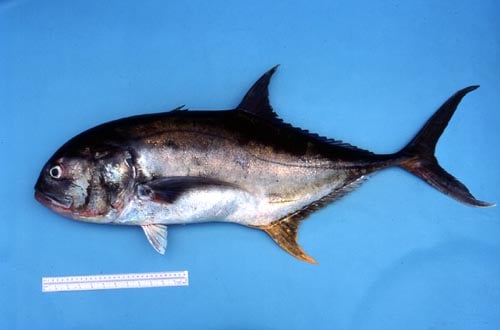
Crevalle Jack
Caranx hippos
Bulldog of the inshore waters — a thick, powerful jack that blitzes bait schools in beaches, passes, and bays from the Mid-Atlantic through the Gulf. Pound-for-pound one of the strongest fighters you'll hook on light tackle.
Taste profile
Dark, bloody, strong-flavored meat with heavy red mudline — generally considered poor table quality. Bleed immediately if keeping.
How to cook it
Smoked
Smoking helps mellow the strong flavor; smoked jack dip is the best preparation.
Not Commonly Eaten
Most anglers release crevalle jack due to the strong-flavored dark meat.
Fish Cakes
Finely chopped and mixed with seasoning, jack can be used in fish cakes or chowder.
Tips to catch one
- ✔Look for bait blowups and diving birds in passes, inlets, and along beaches — jacks push bait violently to the surface.
- ✔Topwater plugs, spoons, and swimbaits draw explosive strikes.
- ✔Use heavy braid (30–50 lb) and a strong reel drag — big jacks will spool light tackle quickly.
- ✔Best fishing in spring and fall migrations; sight-cast to cruising schools in clear water.
Keep it fresh: bleed, spike & ice
🔪 Spike (Ike Jime)
Insert a spike into the brain cavity just behind and above the eye. The fish will shudder briefly then go still — this signals a clean kill that prevents stress hormones from degrading the flesh.
🩸 Bleed
After spiking, cut one or both gill arches at the gill plate junction. Hold the fish head-down in water for 2–3 minutes. Well-bled fish have whiter, cleaner-tasting fillets with a longer shelf life.
🧊 Ice
Place bled fish in an ice slurry (2 parts ice to 1 part seawater). The slurry cools 5× faster than dry ice alone. Keep the drain plug cracked and aim for core temp below 35 °F within 30 minutes.
Size & bag limits by state
| State | Size limit | Bag limit | Notes |
|---|---|---|---|
| Alabama | — | — | No specific regulation |
| Florida | — | — | No size or bag limit; popular catch-and-release species |
| Louisiana | — | — | No specific regulation |
| South Carolina | — | — | No specific regulation |
| Texas | — | — | No specific regulation |