
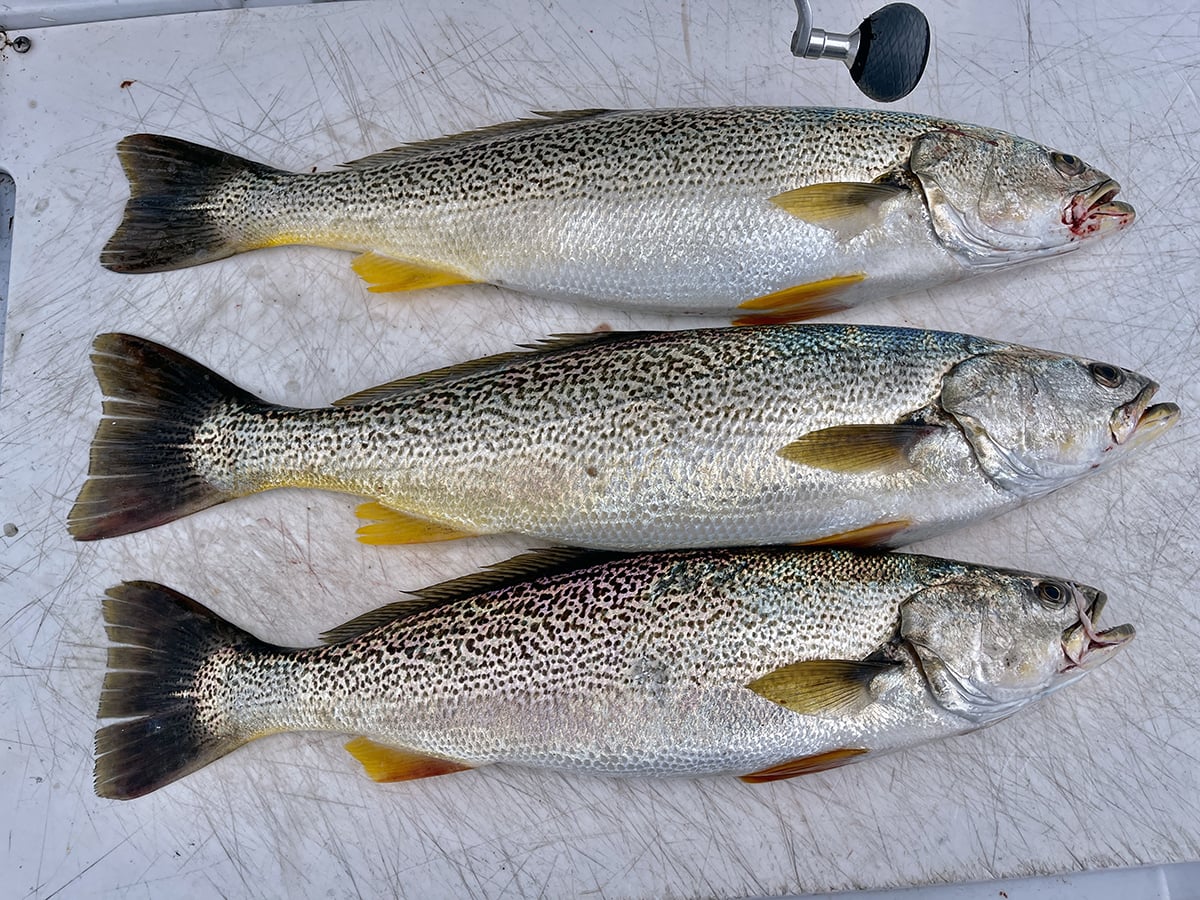
Weakfish (Gray Trout)
Cynoscion regalis
Beautiful, iridescent member of the drum family commonly called 'gray trout' in the Mid-Atlantic. Named for its delicate mouth tissue that easily tears from hooks.
Taste profile
Sweet, white, flaky flesh — delicate and mild, very similar to spotted seatrout but slightly softer. Best eaten within a day of catching.
How to cook it
Pan-Fried
Dust fillets in seasoned flour and pan-fry quickly in butter — weakfish cooks fast.
Broiled
Light broiling with lemon butter works beautifully for thin fillets.
Baked
Stuffed whole weakfish baked with breadcrumbs and crab is an elegant preparation.
Ceviche
The delicate flesh 'cooks' perfectly in lime juice for ceviche.
Tips to catch one
- ✔Fish at dawn, dusk, and night in estuaries, inlets, and back bays — weakfish are most active in low light.
- ✔Light tackle with 10–15 lb line and small soft plastics, bucktails, or live shrimp.
- ✔Use a gentle hookset — their paper-thin mouths tear easily, leading to the 'weakfish' name.
- ✔Peanut bunker, grass shrimp, and small eels are deadly live baits in the Mid-Atlantic.
- ✔Check local seasons — weakfish populations have fluctuated and some states have strict limits.
Keep it fresh: bleed, spike & ice
🔪 Spike (Ike Jime)
Insert a spike into the brain cavity just behind and above the eye. The fish will shudder briefly then go still — this signals a clean kill that prevents stress hormones from degrading the flesh.
🩸 Bleed
After spiking, cut one or both gill arches at the gill plate junction. Hold the fish head-down in water for 2–3 minutes. Well-bled fish have whiter, cleaner-tasting fillets with a longer shelf life.
🧊 Ice
Place bled fish in an ice slurry (2 parts ice to 1 part seawater). The slurry cools 5× faster than dry ice alone. Keep the drain plug cracked and aim for core temp below 35 °F within 30 minutes.
Size & bag limits by state
| State | Size limit | Bag limit | Notes |
|---|---|---|---|
| Connecticut | ≥ 16" | 1 per day | — |
| Delaware | ≥ 13" | 1 per day | — |
| Maryland | ≥ 13" | 1 per day | — |
| Massachusetts | ≥ 16" | 1 per day | — |
| New Jersey | ≥ 13" | 1 per day | — |
| New York | ≥ 16" | 1 per day | — |
| North Carolina | ≥ 12" | 1 per day | — |
| Virginia | ≥ 12" | 1 per day | — |