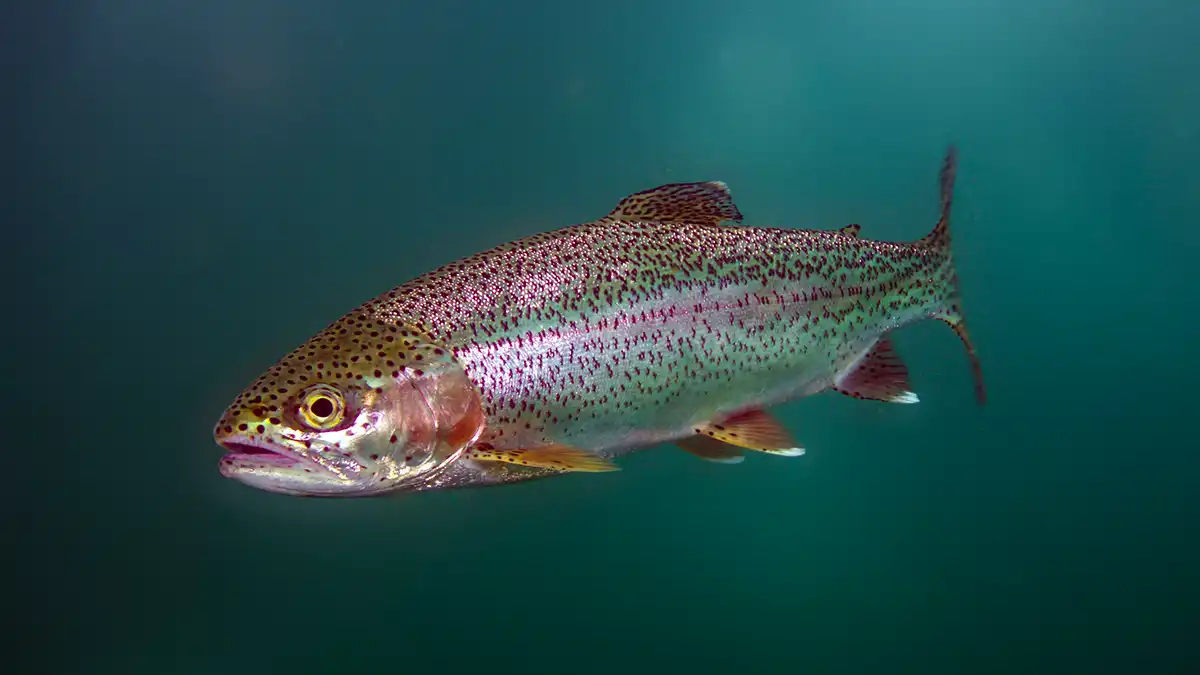
Rainbow Trout
Oncorhynchus mykiss
A beautiful, colorful trout species prized by anglers for its fighting ability and willingness to take a variety of lures and flies.
Taste profile
Delicate, nutty flavor with tender, pink to white flesh.
How to cook it
Pan-fried
A simple and popular method, often with butter and almonds.
Smoked
Hot or cold smoked for a delicious preserved flavor.
Grilled
Whole or fillets grilled over charcoal or wood.
Tips to catch one
- ✔In rivers, drift bait like worms or PowerBait through pools and riffles.
- ✔Use small spinners, spoons, or flies that imitate insects.
- ✔Stocked trout are often found near stocking points.
Keep it fresh: bleed, spike & ice
🔪 Spike (Ike Jime)
Insert a spike into the brain cavity just behind and above the eye. The fish will shudder briefly then go still — this signals a clean kill that prevents stress hormones from degrading the flesh.
🩸 Bleed
After spiking, cut one or both gill arches at the gill plate junction. Hold the fish head-down in water for 2–3 minutes. Well-bled fish have whiter, cleaner-tasting fillets with a longer shelf life.
🧊 Ice
Place bled fish in an ice slurry (2 parts ice to 1 part seawater). The slurry cools 5× faster than dry ice alone. Keep the drain plug cracked and aim for core temp below 35 °F within 30 minutes.
Rainbow Trout — specific tips
Trout flesh is fragile and bruises easily. Spike quickly, bleed in cold water, and handle as little as possible. Keep whole on ice (scales protect the meat). Gut within an hour to prevent belly-burn. Best eaten within 24 hours.
Size & bag limits by state
| State | Size limit | Bag limit | Notes |
|---|---|---|---|
| California | — | 5 per day | Size limits vary by water; check DFW |
| Massachusetts | — | 3 per day | Trout daily limit 3; no min on stocked waters |
| Michigan | ≥ 8" | 5 per day | — |
| New York | ≥ 9" | 5 per day | — |
| North Carolina | ≥ 7" | 7 per day | — |
| Oregon | ≥ 8" | 5 per day | Varies by water body |
| Pennsylvania | ≥ 7" | 5 per day | — |
| Washington | ≥ 8" | 5 per day | Varies by water body |